Wednesday, July 6, 2011

Google Me (2007, Killeen)

Rating: **1/2

Every truism has at least the potential of setting our mouths ajar to utter a mindless “wow”, before we come to our senses and rightly dismiss it as drivel. “We are all connected” is only one of the bunch, and yet Jim Killeen managed (doggedly and sometimes strenuously) to build a documentary around it. Google Me opens with a simple premise of Jim googling himself and setting out to connect with his namesakes around the world. Who are they? Are they like himself? Are they – yes – “connected” by something more than mere name…?

As it turns out (surprise, surprise), the Jims are not at all alike. There’s a priest, a swinger, a couple of others (an all-white crowd, by the way). Killeen hops around the globe asking his fellow Killeens a question about “a man’s purpose”.

With his James Gandolfini-like smirk and generally affable presence (not to mention a blatant self-dramatization resembling Brian Herzlinger’s narcissistic turn in My Date with Drew [2004]), Killeen makes for a tolerable subject, but there is an element lacking – both in him and the movie at large – that has something to do with want of responsiveness. For all the differences between various Jims, the central one reacts almost identically to every one of his namesakes – that is with an open smile and a perfunctory curiosity. He meets plenty of people; yet you hardly feel he encountered anyone by the movie’s end.

Google Me is a skin-deep odyssey in search of the meaning of life, which stops short of a becoming a true journey of self-discovery. Instead, it’s a series of mostly boring interviews, with some shamelessly touristy inserts, all stressing various cultural differences (Jim’s squirming over a Vegimite sandwich is a visual equivalent of an entry in a “Xenophobe’s Guide to Australia”).

Part of the movie’s charm – if “charm” is the right word for sufficiently inoffensive naïveté – lies in its touching formal semi-flourishes. First-time filmmaker Killeen can’t help himself but insert his own reaction shots into the interviews (some of the double takes seem painstakingly re-enacted and don’t gel with the interviewees’ expressions). However, as is the case with most silly follies, there are bits that seem almost inspired, some having to do with Killeen dramatization of his hilariously pat mid-life crisis at the very beginning of the movie.

Wednesday, May 11, 2011

Meeting Andrei Tarkovsky (2009, Trakovsky)


Quiet and understated as it is, Meeting Andrei Tarkovsky is a highly personal attempt at summoning a seemingly dead cinematic spirit. Dmitry Trakovsky’s quest to locate Andrei Tarkovsky in the immediate present goes far beyond a simple search for his “influence” or “following”. What Trakovsky sets out to achieve is to find out the ways in which Tarkovsky is still alive, and that’s why the movie’s single act of formal daring may be its beautiful, if misleading title. Instead of “searching” or “remembering” Tarkovsky, this new documentary hints boldly at his persistent, real, and this-wordly presence. The latter may manifest itself in memories others have of Tarkovsky, but it also finds a material dimension in his son Andrei Andreevich. Finally, and most poignantly, the filmmaker points to numerous people whose life choices were forever altered by encountering Tarkovsky’s films. As we’re watching the serious, unsmiling and yet serene face of a young Orthodox monk, as he’s declaring Tarkovsky’s work as the single most decisive factor in his choice of becoming a man of cloth, it’s hard not to think of Tarkovsky as still living through the existence of this man.

Structurally, the movie is conceived a series of encounters rather than as a multi-voiced narrative created in the editing room. In effect, we’re dealing with specific people rather than with floating clusters of themes – each interview has its own dynamic and we never come back to a person once they’re finished telling their story. This simple device allows us to feel the vocal rhythms of particular interviewees, and makes for a rather contemplative and strongly immersive viewing experience, especially considering how little in terms of flashy camerawork or overtly self-conscious technique Dmitry Trakovsky uses here.

Depending on the viewer’s sensibilities, different accounts will sink deeper than others (although my guess is that the flamboyantly moralistic, blatantly self-aggrandizing huckster delivery by Krzysztof Zanussi will be no one’s favorite). Overall, this wonderful documentary circles around its subject hesitantly and respectfully, and yet does not flinch at revealing his less appealing sides (namely his way of treating women as “B-class people” pointed out by the still-ravishing Nostalghia [1983] star, Domiziana Giordano).

To someone like me, who grew first to love Tarkovsky’s work and then to object to it, Meeting Andrei Tarkovsky is indeed like meeting an old mentor; someone once revered, then rebelled against, and yet never quite exiled from one’s head. At this point in my life, I mostly resent Tarkovsky’s disdain for secular order of things and for earthly concerns. It strikes me more and more that his elaborate search for spirituality was almost a way of avoiding the question of happiness and branding it a selfish pursuit at best. Still, I may come to love Tarkovsky once more some day, and Meeting… certainly made sure that I don’t ever want to forget him.

[Meeting Andrei Tarkovsky can be purchased here.]

Friday, March 18, 2011

Midnight Movies in Wrocław

Hi guys,

this July, I'm curating a series devoted to midnight movies for the Era New
Horizons Film Festival in Wroclaw.

As an accompanying event, my translation of "Midnight Movies" by J.Hoberman and
Jonathan Rosenbaum will be published, and both authors confirmed that that they will appear at the festival.

Here's the full program, as well the introductory essay I wrote (in English,
which was then translated into Polish):

http://www.enh.pl/artykul.do?lang=en&id=940


For some reason, I can't link directly to the English site, so if you get
redirected to the Polish one, just click the "English" button at the top left corner of the screen.

Hope some of you can make it to Poland this July!

Friday, February 18, 2011

Another Year (2010, Leigh)


Rating: ***

Another Year is so familiar it feels rigged. It’s a superbly crafted and deeply affecting movie, and I advise everyone to see it, yet there’s something in it that I object to, and the following remarks are an attempt at defining this troubling element.

For a director so often (and justly) praised for his all-encompassing humanitarian approach, Leigh seems strongly drawn to the notion of duality: behavioral, structural and even visual. His most memorable images are two-shots, like that famed long take of Cynthia and Hortense in Secrets & Lies (1996), having their long exchange at an empty café, or the magnificent closing shot of two nursing mothers in Four Days in July (1984). What I find troubling in Leigh (whom I consider to be one of the greatest directors in world cinema), and what significantly taints Another Year in my view, is his habit of pitting characters against each other while giving them biased treatment – not in terms of empathy, which is spread rather evenly in each film (save Who’s Who [1979]), but in terms of applying frank and unflinching insight.

In Another Year, Tom and Gerri, the central married couple played by Jim Broadbent and Ruth Sheen (who’s a God’s riff on Shelley Duvall), seem to have attained the Holy Grail of modernity (or at least of a successful therapy): they’re balanced without being rigid. Leigh’s distribution of anxiety is brazenly uneven – it’s Mary, played by Lesley Manville, who embodies it in the world of this movie. Mary keeps “popping in” to visit her friends, her nerves perpetually frayed and hands all aflutter (she’s a neurotic twin to Brenda Blethyn’s chirping Gloria in Grown-Ups [1980]). She’s a lush; a walking mess in constant need of validation who takes hostage anyone foolish enough to grant her their full attention. Each time Tom and Gerri are with her, they can’t help but mildly (and understandably) condescend to her.

What I mind about this film is, ultimately, that Leigh goes soft on Tom, Gerri and their son. Happy chatter is a way of life for them, and nothing seems capable of breaking their constant merriment. It may even be that nothing truly touches them, thanks to the armor provided by Leigh, who feels more protective of them than of a character like Mary, who gets straightforwardly admonished at the end for her selfish ways. It is the same admonishment one witnessed in All or Nothing (and again, it was the Lesley Manville character who had to undergo it), and in Happy-Go-Lucky (2008), in which Leigh went as far as branding the Eddie Marsan character unredeemable (even his teeth were rotten).

The last shot of Another Year is masterly: Mary’s face gets alive for a second, and then – as soon as she’s no longer the center of attention – she goes blank, recoils, and even the soundtrack goes silent as she fails yet again to weave herself into the lives of others. Leigh is capable of this amazing insight, and yet guilty of carefree idealization of Tom and Gerri, who are so quaint they’re sugarcoated. Jim Broadbent’s old codger and Ruth Sheen’s mother-earth-fancy-a-cuppa are presented as beacons of sanity, whereas they’re not even fleshed out enough to require sanity in the first place. They don’t seem to have contradictory forces in them to balance out, so how can we learn from them; much less believe in them…?

It may be that Tom and Gerri’s mysterious contentment is so much up Leigh’s alley that he exempts them from satirical incision, only to apply it forcefully to Mary. Much like the central married couple, he’s a gardener in a greenhouse of his rich creation. Some flowers he tends to, and reverently – some, he can’t help but nip.

Tuesday, February 15, 2011

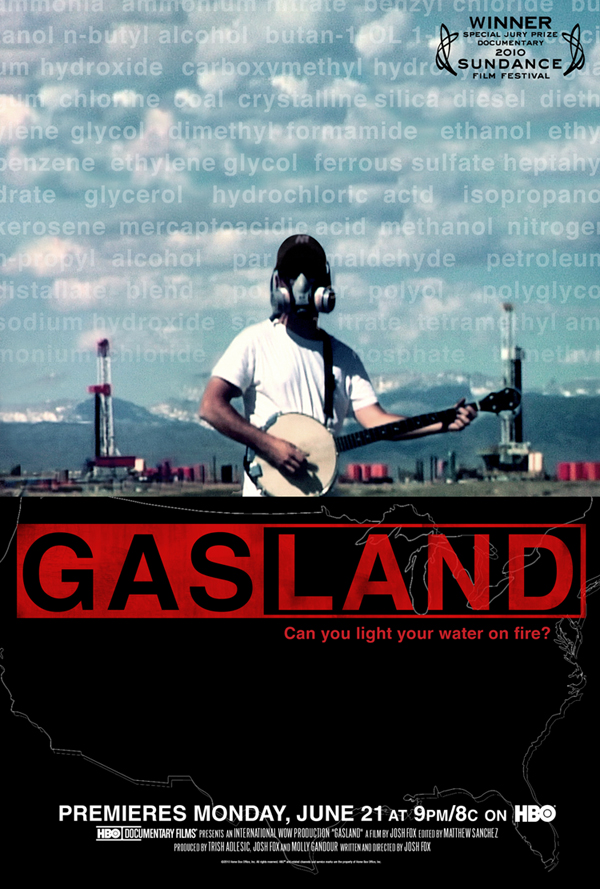
GasLand (2010, Fox)


Rating: ***1/2

Civic concern rarely produces great art, but if it results in a lean, conscientious piece of filmmaking, you can’t help but welcome the results. Josh Fox’s GasLand, a muckraking investigative documentary on the unacknowledged side effects of natural gas drilling across the U.S., makes one angry without stooping to rabble-rousing tricks.

Josh Fox has a non-actorish, yet concrete and affable on-screen presence, which saves GasLand from joining the Michael Moore school of agit-prop romps. Moore, to an unprecedented extent, combined the role of a clown with that of a reporter – by turning himself into a star of his movies, he got closer to the legacy of Robert Benchley than to that of Robert Flaherty.  The most troubling thing about Moore’s approach was that he blurred the line between muckraking and self-aggrandizing (something Fox avoids altogether).

That is not to say that he lacks wit as a filmmaker. He’s perfectly capable of pointing out funny details he stumbles upon in his quest: the highlights include “the most comfortable couch in the United States”, as enormous as it’s furry (it even sports a tail), which Fox finds in one of the visited homes. Still, there are no knowing winks that would condescend to the interviewees (or to us).

Fox’s touch does falter, but so scarcely that it’s hardly worth mentioning (he’s a bit too zoom-happy when one of his subjects is on a brink of tears, and he lingers too long on the frozen critters killed by one of the leaks).

The movie’s steady refusal of falling into genre patterns borrowed from fiction moviemaking is what makes it fresh and affecting. You can praise The Cove (2009) all you want, but there was something cheap and demeaning in that movie’s eager tapping of spy-thriller devices, with the music pounding and with the editing trying to bend the (already horrific) reality, so that it meets the audience's hunger for thrills.

Fox’s near-deadpan tone of voice, along with his restraint from employing hip flourishes make his sole flight of performing fancy (a banjo concert in a gas-mask, played against a backdrop of land covered with porcupine-like field of gas derricks) come off as very poignant. When, at the very end, he addresses the audience and requires its political participation, you don’t feel manipulated, but alerted to something that matters – and you may acutually breathe a sigh of relief at being treated like an adult.

Friday, February 11, 2011

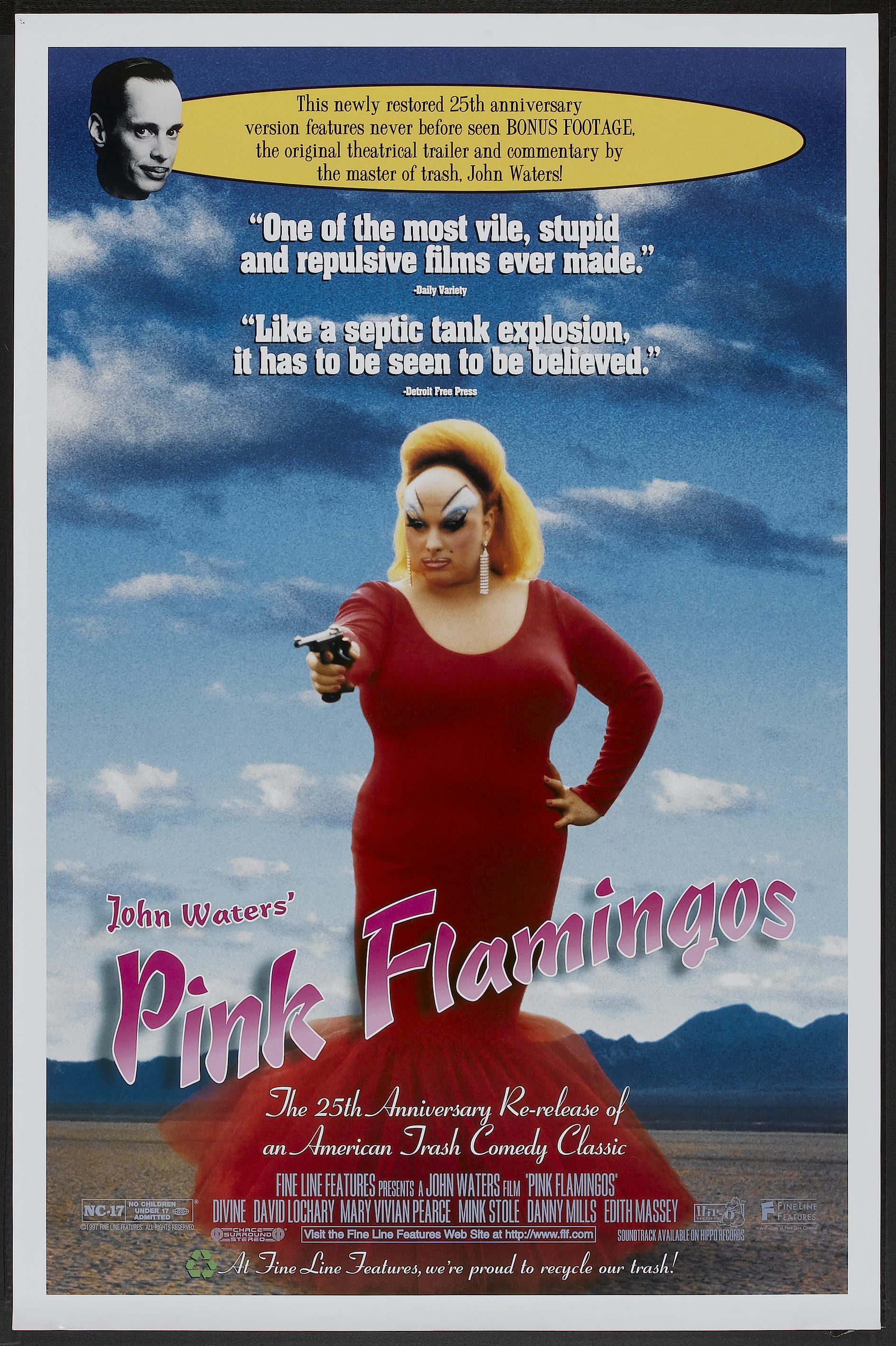
Pink Flamingos (1972, Waters)


In John Waters’ movies, filth is bliss, and Divine (every homophobe’s nightmare, per Piotr Mirski) makes a great slob Marlene to grace his Sternberg-like tribute. The first color feature they made together, Pink Flamingos not only proved an instant box-office sensation, but revealed a tender streak in Waters that no one (even him) can deny – or resist. The story is one of savage rivalry between Divine’s multi-generational trailer-trash family and a couple engaged in grotesque sex trafficking: the prize they all crave is the title of “the filthiest people alive” (and Waters does them all one better by making his movie, of course). 

Assorted atrocities include grossly ravished chickens and eagerly gorged dog’s feces, so that the film seems to condone Divine’s on-camera capsule of her political beliefs: “Kill everyone now”. Still, Pink Flamingos depicts a family unit that – however wacky – is not exactly dysfunctional, and there’s no denying that the sinister couple played by David Lochary and Mink Stole is in such a perfect sexual sync, and so devoted to one another, that you can’t help yourself but want to be like them when you grow up.

Tuesday, February 1, 2011

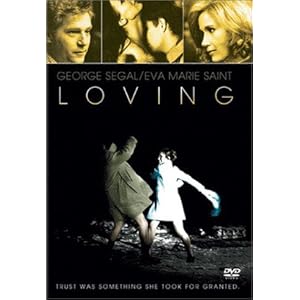
Loving (1970, Kershner)


Rating: ****

Everyday tensions build up beautifully in Loving (1970). And yet the way they flow, one doesn’t feel pushed to overstate their significance. There’s no grotesque overflow of mishaps in the life of Brooks Wilson, the philandering New York graphic designer played by George Segal. His middle-age crisis doesn’t usher a cosmic rupture of the sort Charlie Kaufman will convey in Synecdoche, New York (2008), a movie that Loving somewhat resembles.

Since we learn early on that Brooks has promised his mistress to inform his wife about his affair, he’s like a walking time bomb for us. There’s not scene where Segal wouldn’t hint at his character’s back-burner operating full-tilt. He watches his wife (Eva Marie Saint, in a performance to match Segal’s), his kids and his house, and all the time one can hear him asking: is it worth to jeopardize all this…?

Brooks’ sexual longing (suggested, in the movie’s single instance of literal-mindedness, by “imaginary” inserts of him having sex with his lover) is palpable throughout. The force pulling him towards adultery is sweetly, yet painfully insistent. At the same time he starts to see his family as an imperiled unit – everyday bickering and mess are annoying, but not annoying enough for Brooks to make the incision it would take to move on to something new.

The way Segal plays Brooks, he’s both meek, mean, level-headed and volatile. This may be one of the towering (yet still virtually unsung) male performances in American movies. Brooks’ final act of adultery, made into cruelly insensitive sexual slapstick by a device I won’t reveal here, is the high-point of the film. Segal gives in to temptation from the inside of his character: he’s not telegraphing anything.

Irving Kershner’s sense of textural richness seems all-encompassing. There’s not a scene in the movie that could be called perfunctory, or one that would give the impression of being too glib or hasty (and yet Loving clocks in at a neat 89 minutes!). Gordon Willis’ cinematography gives a charge to sets that would otherwise feel commonplace (although I felt that there were a couple of shots in which he overdid his Hey-look-I’m-Rembrandt shadowy self).

This is by far the best movie I’ve seen in a long time. The only director working nowadays that shows a talent similar to Kershner’s is, to my mind, James Gray. I can’t wait to see some more of Kershner’s early stuff – too bad there’s so little of it available on DVD…