Sunday, November 28, 2010

Tangled (2010, Greno, Howard)


Rating: **1/2

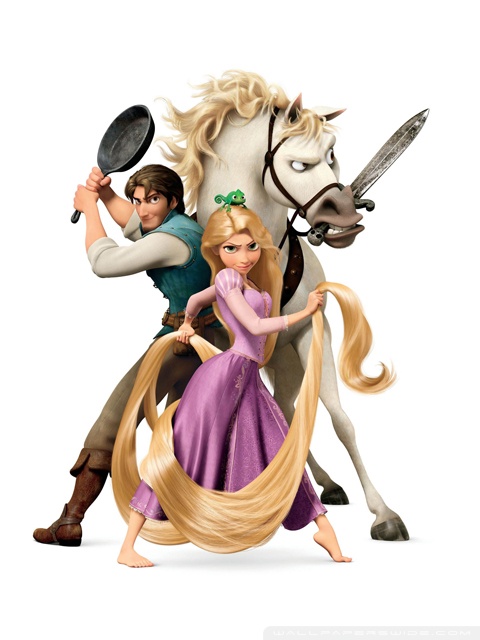
Tangled is a very strange title for any animated feature, not least for the 50th animated feature coming from the Walt Disney studios (it seems more like something out of early Fassbinder – or late Julia Roberts). The movie, though enjoyable, has a rather dull look to it – all honeyed golds and pinks, like those Barbie (or My Little Pony) straight-to-DVD movies that you don’t want your kid to watch. What’s more troubling, though, is that there’s little sense of wonder in the whole production. The script sits rather uneasily between a straight retelling of the Rapunzel fairy tale, and the morbidly Shrekian notion of destroying all faith in fairy tales as such. Once the off-screen narration begins and you hear the compulsive, self-conscious (and borderline apologetic) qualifiers in the first couple of sentences, it’s easy to get apprehensive – and for a reason.

The movie doesn’t really believe in the elation of romance, or rather – it believes in it and it doesn’t, by turns. You won’t find anything in Tangled that would match the silly energy and giddy flow of the “Whole New World” flying-carpet sequence from Alladin (1992) – here, when Rapunzel leaves her tower for the first time, she becomes so anxious and guilt-ridden that her brief shrieks of joy are interwoven with violent sobbing and therapy-session banter between her and the Flynn Ryder character. It works as a joke, but undercuts the inner workings of the story and makes the final pay-off matter less.

I liked most of the film, but it lacks a sustained tone as a whole. I’d much prefer the filmmakers to take sides more forcefully: either they’re into the whole ironic deconstruction thing, or they tell an engaging, energetic tale of magic, romance and adventure. It was the unity of tone made The Princess and the Frog (2009) so successful and it's the lack of it that makes Tangled, well, flawed.

Monday, November 22, 2010

Breathless (1983, McBride)


Rating: ***1/2

Jim McBride’s Breathless (1983) is in many ways even more radical an aesthetic statement than Godard’s celebrated 1959 version. By switching the nationalities of the main couple, as well as by trading Paris for gaudy California, McBride shifted the meanings of the original material, and yet managed to preserve its core. The main theme here (as it was in Godard) is the displacement of an individual in democratic (i.e. Americanized) culture. McBride’s protagonist is even more steeped in pulp references and there’s more glee in his infatuation with the Silver Surfer comic-strip character than there was in Belmondo’s emulating Bogart’s cool.

McBride’s forceful visual style, and his stunning use of expertly choreographed long takes (my favorite is the long, teasing sex scene involving imaginative use of an answering machine and a plate-glass shower curtain), owes more to classical Hollywood storytelling than to Godard’s jump cuts. Thus this Breathless may seem less distanced from the popular culture intoxication that it both mocks and embraces. The scene with the couple making love in front of a movie screen on which Joseph H. Lewis’ Gun Crazy (1950) is playing, is both tacky in its shameless TV-ad-like gloss and stunning in how literal-minded and arresting its central metaphor is.

Thursday, November 11, 2010

Unstoppable (2010, T.Scott)


Rating: ***

More of a fun ride than a movie proper, Tony Scott’s Unstoppable makes no claims to subtlety, and is in many ways an even more radical disembowelment of the modern action flick genre than Scott’s jittery Taking of Pelham One Two Three (2009) remake – with which it shares a star, a style and (though this remains to be seen) probably a box office pull.

The premise of having one million tons worth of steel blindly speeding down the railroads of industrial Pennsylvania has an dumb impact of its own. Having cast Chris Pine – for whom the earthly mph must be something of a trifle after having experienced the warp speed in last year’s Star Trek (2009) – and Denzel Washington as the two barely-delineated but amiable buddy-leads doesn’t hurt either.

Unlike in Jan de Bont’s Speed (1994), the menace here is the speed itself, and not just any stock-psycho (be it Hopper, be it Travolta) spurting demands and/or prophecies into his phone (thus transforming the hair-raising action sequences into moral struggles between good and evil).

Now, a stray unmanned train speeding toward doom isn’t exactly tough to politicize, either. One can clearly see Scott sympathies lying with the blue-collar workers whose guts, hunch and experience save the day in spite of the big bosses’ failed attempts to act. (This working-class optimism is so clear-eyed and populist that we are never pushed too far to acknowledge the obvious guilt of Ethan Suplee’s slob-mechanic, whose very negligence triggered the whole event and resulted in a death of one person).

Still, the movie is so unashamedly mechanical and its mode such a willful assault of our senses, that after 100 minutes of Scott’s signature firecracker-zooming, compulsive fast cutting and non-stop flow of Harry Gregson-William’s throbbing score, one can end up too exhausted to fully partake in the closing on-screen elation of a feat spectacularly accomplished.

Saturday, November 6, 2010

Due Date (2010, Phillips)


Rating: ***

With all its lazy sitcom writing and its grating overload of dog reaction shots, Due Date strikes me as this year’s most rousing comedy, thanks to a happy pairing of two extremely odd and brilliant comic actors. The volatile straight man Robert Downey, and the hirsute nutball Zach Galifianakis make a great team together.

Todd Phillips doesn’t have the scale (or sensitivity) of, say, Jonathan Demme: his mix of abrupt action sequences and run-of-the-mill character comedy is purely mechanical, and never does it account for a genuine shift in tone. The shocking jolts (car crash, gunshot, etc.) keep coming and never truly disrupt the characters’ comic rapport with the audience. Still, it’s due to Phillips’ remarkable timing that those jolts aren’t just slapstick effects devoid of consequences. There’s a dark, surrealistic streak in Phillips that came to light a year ago in The Hangover (2009), and is on display in Due Date, as well.

The new movie is more dutiful in hanging onto generic rewards offered by the buddy movie, but the oddity of particular choices made by Downey and Galifianakis defy all conventions. (The scene in which Downey spits in the little mutt’s muzzle in ager has a raw energy that’s both scary and convulsively funny.)

Saturday, October 23, 2010

Kaboom (2010, Araki)


Rating: **1/2

Garishly tinted, wilfully sophomoric (and only intermittently funny), Greg Araki’s Kaboom wears its credentials on its sleeve, being  its father’s baby through and through. This broad rehash of Donnie Darko-style prescient dread, served as a sex-and-gore farce, relies so much on its characters’ involvement in their absurd predicaments, that it risks missing out on an audience not trained in Araki’s ways.

Nothing less than an Apocalypse-update (the world indeed goes ka-boom in the end), the movie is a story of multiple awakenings and recurring nightmares, building up and canceling each other out at the same time. The main character’s visions of baleful figures wearing animal masks go hand in hand with his bisexual flings, and it’s to the movie’s credit that for most part these two strands are equally engaging.

It’s only towards the end that the cluttered narrative wears one down, and when the whimsical dénouement finally arrives, it’s a cop-out of sorts. The movie seems to be saying that its own democratic vision of an orgasm-chasing, politically inane humanity is not enough to sustain the story – or the world, for that matter. In that sense Araki (as usual) makes a half-desperate, half-prankish gesture towards the void, telling us that we can’t afford anything but a self-destructive joke (and its slow petering out before our eyes may be integral part of his vision).

Friday, October 8, 2010

Polish Film Series in Dublin


On 16th and 17th October it will be my pleasure to host a Polish film series at the Irish Film Institute in Dublin. I programmed the series so that the overall theme of the presented movies deals with “Civility in Crisis”. There will be four features in the series: The Treasure (1948), How to Live (1977), O-bi, O-ba: The End of Civilization (1984) and Zero (2009).

(Click on a title to see the exact times for each screening and a short program note I wrote).

Each screening will be preceded by a short introduction.

Hope to see you in Dublin!

Saturday, October 2, 2010

Lucky Life (2010, Chung)


Rating: ***

In Lucky Life (2010), Lee Isaac Chung’s quietly accomplished second feature, the camera often abandons the characters to ponder their surroundings in a free-flowing (yet somber) manner that seems to owe a lot to the work of Terrence Malick. Shifting freely between tightly structured dialogue and seemingly improvised scenes of friendly badinage, the movie is quite formidable in asserting it slow pace and making the viewer respect its rhythms – as well as respond to them.

A story of a loss as much as it is a chronicle of a budding commitment, Lucky Life takes an unflinching look at the process of forgetting, or rather replacing memories with fresh perceptions. The death of a friend is interwoven into the whole structure in a recurrent fashion, so that is seems less a singular event, and more a dream that will remain dormant for years, only to seep into one’s thoughts years later.

Overall, it’s a sustained piece of work that makes me look forward to Chung’s future projects.

[The film will be presented as a part of the American Film Festival in Wrocław]