Monday, May 3, 2010

Adam & Paul (2004, Abrahamson)


Rating: ***1/2

*SPOILERS*

Shared addiction breeds a special kind of fraternity. Perpetually centered on the ever-desired substance, drug-buddies seem to act in perfect sync with one another, almost as if they were reading each other’s minds. This symbiotic relationship makes a great material for comedy: hence Up in Smoke (1978) and Strange Brew (1983). But Lenny Abrahamson’s great Adam & Paul (2004) manages to see through the comedy and gets to show the devastating despair that fuels its characters. Abrahamson’s feat in this movie is, in a way, to see double: the comedy doesn’t serve as an intro for the drama, and the latter doesn’t serve as the “truth” undermining the former’s status. Comedy and despair coexist in this strange and beautiful movie – they don’t merely show up by turns.

Adam (Mark O’Halloran) and Paul (Tom Murphy), a pair of Dublin junkies, are on the hunt for some heroin. It’s exactly one month ago that their best friend O.D.’d, and by the end of the movie the eponymous team will shrink yet again, leaving but one name in the equation.

Abrahamson shows amazing formal restraint in suggesting the characters’ spaced-out state of mind. No hazy p.o.v.’s, no twitching fast-forwards, no succumbing the image to any pulsating rhythms, Arronofsky-style. Thanks to very rigorous framing and noticeable reluctance to surround the characters with inconsequential passers-by, Adam and Paul seem to be isolated from the society that enfolds them. In the director’s commentary – available on DVD – Abrahamson says that he was thinking of their actions as a kind of a strange ballet, and that quality of subtle artifice is there on the screen. (It’s also interesting to know that Abrahamson screened Bruno Dumont’s movies for his screenwriter and star, Mark O’Halloran – Dumont being one of the prime examples of deliberate artifice in portraying cryptic working-class characters.)

Adam and Paul seem hungry for an instant redemption that fantasy alone can provide – and then only temporarily. The beautiful, painfully transient sequence in which they’re both daydreaming about taking care of a baby, has all the sound drawn out and seems all the more unattainable for it.

Abrahamson is expert at withdrawing moral judgment and keeping us from sentimentalizing his “Laurel and Hardy on smack” (per DVD’s cover) pair of characters. And even though Paul – because of his wide-eyed, seemingly childish face – seems the “innocent” one,  it’s him who perpetrates most of the film’s reprehensible acts, including the devastating final pillaging of a dead friend’s body.

Overall, I was surprised and humbled by the scale of talents revealed by this movie’s director, screenwriter and actors. I’m about to watch Abrahamson’s second feature, Garage (2007), and I can only hope it’ll be as good as this one.

Monday, April 26, 2010

The Next Voice You Hear... (1950, Wellman)


RATING: ***

It’s tempting to take easy shots at The Next Voice You Hear… (1950), William A. Wellman’s literal-minded religious fantasy, in which God adapts to the realities of mass-culture era and broadcasts His message all over the world on the radio.

However, both the material and the way Wellman directed it, are far from banal. James Whitmore’s portrayal of a well-meaning workingman, weary of his daily routine and desperately seeking for comfort of any kind, is in fact very powerful. The source of his angst is his wife’s pregnancy – the dread of lurking labor and possible harm she can suffer is rendered very matter-of-factly. Whitmore’s irregular face is great at expressing confused emotions of his character.

The movie sags when God’s message is cut to a catchphrase-size of a homey “take it easy”. But most of scenes have both rhythm and substance, and there is remarkably little of the condescending tone that pushed the thematically close Red Planet Mars (1952) into the realm of camp, which The Next Voice You Hear… never enters. It’s hard to call this movie a heartfelt piece of work, since the main premise of injecting faith into the hearts of doubters is treated without zeal – but it’s a solid enough movie to keep the viewer from dismissing it as a mere exercise in manipulation.

Tuesday, April 6, 2010

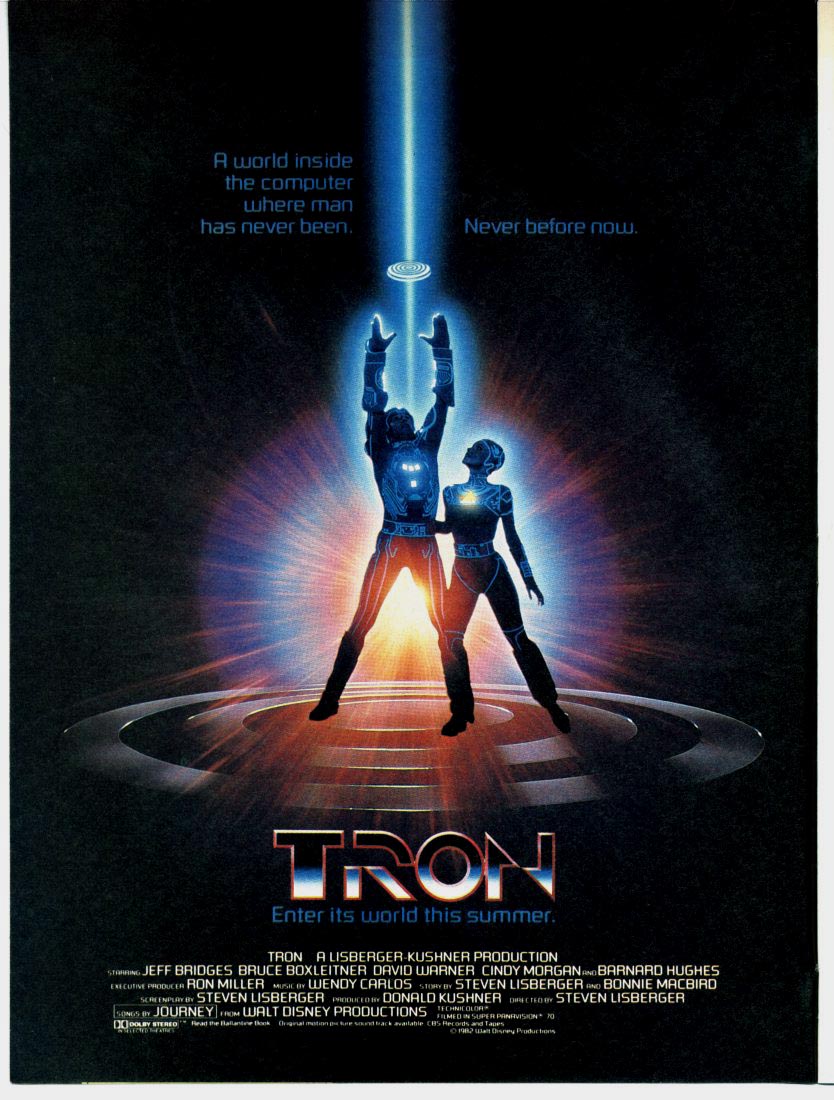
TRON (1982, Lisberger)


Rating: ***1/2

Widely dismissed at the time of its original release, TRON (1982) holds up amazingly well. I’d be hard-pressed to decide whether the effect it had on me was inherent to its design or was it merely contextual (resulting from the fact I watched it now, in 2010) – but it hardly matters. The wonder of TRON as it unravels before our CGI-weary eyes is that its artifice doesn’t seem quaint or campy. In fact, the movie may seem more high-concept today than it did at the time it was conceived. We grew so accustomed to the Spielbergian notion of lifelike CGI (set up in the 1993 Jurrasic Park and obeyed by everyone since, James Cameron included), that the overt artifice of TRON seems so much more refreshing. All lines crystal-clear, all contrasts wildly overstated, the visuals mesmerized me and seduced me beyond anything I saw at IMAX those last couple of years.

True, it gets dull every time the animation takes over completely and the fascinating interplay of human figures with the dreamed-up background is lost. But this is a slight deficiency. The movie is still a grand canvas, all covered in garish fluorescent-marker design. It never enters the cozy territories of the eco-friendly Pandora. The visuals in TRON are razor-sharp; we don’t get any of the cloying fuzziness that repeatedly contaminates our current CGI-driven extravaganzas (every figure in those swaying crowds CGI gives us sways the same way, did you notice…?).

Shot against this framework, the black-and-white, slightly flickering human faces are all the more impressive – an effect that Lars Von Trier or Wim Wenders wouldn’t be ashamed of.

Waking up this morning, I didn’t expect that this will become the day I fell in love with TRON, but there you go. I’m even shamed into admitting I’m curious about the remake. If done right, this may be the movie that opens a new frontier for CGI techniques. If done wrong, it can become another Alice in Wonderland (2010). Let’s wait and see.

Saturday, March 27, 2010

Two Lovers (2009, Gray) [Audio Commentary]


Here’s the first part of my audio commentary on James Gray’s Two Lovers (2009), a movie I love and admire. The second part is to be found here.


Tuesday, March 23, 2010

Schickel vs. Schickel


The recent disparaging attack on the critical profession made by Richard Schickel was pretty astounding; even more so for those who (like me) still consider Schickel’s 1968 article one of the best and most clear-eyed manifestos of adventurous film criticism. Here’s the Schickel I prefer:

It seems to me that all criticism is an effort at self-integration, and while a plausible case could be made that such efforts are harder to bring off in our fragmented and alienation-prone times, it is difficult to believe that the movie critic is uniquely cursed. All of the arts are, and for some time have been, in a state of flux bordering on anarchy. Is it harder for the movie critic to leap from Andy Warhol to Ingmar Bergman than it is for the art critic to leap from Warhol do Willem De Kooning? I don’t think so. There are few absolutes left in life or in art, and for the critic this ought to be less a burden than a challenge. It makes his work more of an adventure, perhaps more of a creative experience than it may have been in more settled times, when a recourse to academic rules of artistic composition could settle more arguments then they now do.

It seems to me that the modern critic is, in fact, luckier than most of his contemporaries, for he is regularly forced to sit down in front of a blank sheet of paper and coherently organize his responses to a wide variety of stimuli. There is no better integrative experience available, and the critic's good fortune consists precisely in being obliged frequently to undergo it. If, at the outset, he finds it painful, he will soon develop his spiritual and intellectual muscles to the point where he can accomplish his particular yoga exercises with relative ease. Or he will cease to be a critic. Or he will be such a poor one that he will have little influence.

(Richard Schickel, Introduction [in:] Richard Schickel, John Simon (ed.), Film 67/68: An Anthology by the National Society of Film Critics, New York 1968, pp. 13–14.)

Wednesday, March 17, 2010

Daddy Longlegs /aka/ Go Get Some Rosemary. (2009, Ben & Joshua Safdie)


Rating: ***1/2

As if taking cue from its erratic and impulsive main character named Lenny (Ronald Bronstein), Go Get Some Rosemary. (2009) is stylistically restless, distributing plot information in uneven chunks. It isn’t until half-hour into the movie, for example, that we learn what Lenny’s job is (he’s a projectionist in a repertory theatre). What we witness in detail are his dynamic – and sometimes violent – interactions with his ex-wife, his girlfriend, his kids and their teachers.

The movie is a heartfelt and frank love-hate-poem to bad parenting; an anti-White Ribbon (2009) of sorts. Lenny’s way of cutting the kids huge slack is joined by his total recklessness, culminating in sedating his offspring into near-coma when he can’t find anyone to keep an eye on them. And yet his fatherly love is so evident that we don’t question it even when he shows violent impulses (both towards the kids and towards other adults with kids present). Lenny doesn’t shelter his boys from the aggression: by exposing them to it, he hopes to condition them to deal with it themselves (when the boys’ teacher scolds one for pulling the other’s hair, Lenny orders the victim to pull the culprit’s hair, too – an experiential approach).

Lenny, who screens black and white screwball comedies at work, is like a classic female from one of them himself: mercurial, whimsical, impulsive, fun to be around – and a peril. The movie is a crazy and engrossing dream of what it would be like if Susan from Bringing Up Baby (1938) actually were bringing one up. The way things work in Go Get Some Rosemary. (mere title being a parental imperative in itself, complete with a reinforcing dot at the end), the parenting is all about redefining authority. Not really challenging it (see the scene in which a class solves a math problem on the teacher’s back), but making it seem real and connected to the kid’s level of perception.

The style of the movie is much-indebted in Cassavetes’ work, as is indeed the main character: a male and scruffy Gena Rowlands. The raw, aggressive, inquisitive camerawork, fast cutting and improvisatory feel come together beautifully and end up creating a benign variation on yet another bad-parenting masterpiece, namely the Dardennes’ The Child (2006) – with a great nod to the Cronenberg universe along the way, but I’ll be damned if I spoil that one for you.

[Note: The movie will be screened as part of the upcoming Off Plus Camera Independent Film Festival in Kraków; more information here]

Tuesday, March 9, 2010

Lebanon (2009, Maoz)


Rating: **

Even though usually I’m a total sucker for conceptual genre-bending, Samuel Maoz’s much-praised Lebanon (2009) rubbed me the wrong way.  It seemed aesthetically fake, if not wrong-headed. The high-concept here is that the camera doesn’t leave the inside of an Israeli tank during its mission in Lebanon in mid-1982. Had this rule been followed avidly, the result might have become fascinating. Unfortunately, Maoz is set on having his cake and eating it, too. The camera doesn’t leave the tank, all right, but the tank’s periscope is in constant use and boy, these soldiers would make for a great team of DPs! Framing and camera movement in the long periscope-p.o.v. scenes are so clear and focused, so centered, so little obstructions get in their way, they might as well have been shot from the outside. There is no restraint to this movie’s visuals other than the constant mechanical whizzing of the periscope each time it slides this way and that. All minutiae facial expressions  are picked up, all found symbols on full display.

Another problem is the stereotypical presentation of the conflicts within the male group, as  well as the hopelessly cliché-ridden moments of buddy-truth. All this is buried under tons of seeming formal restraint and experiential intensity, which in the end proves nothing more than a cover-up for obvious sentimental pulls and banal statements about war’s violation of human dignity.