Wednesday, February 17, 2010

The Lovely Bones (2009, P. Jackson)


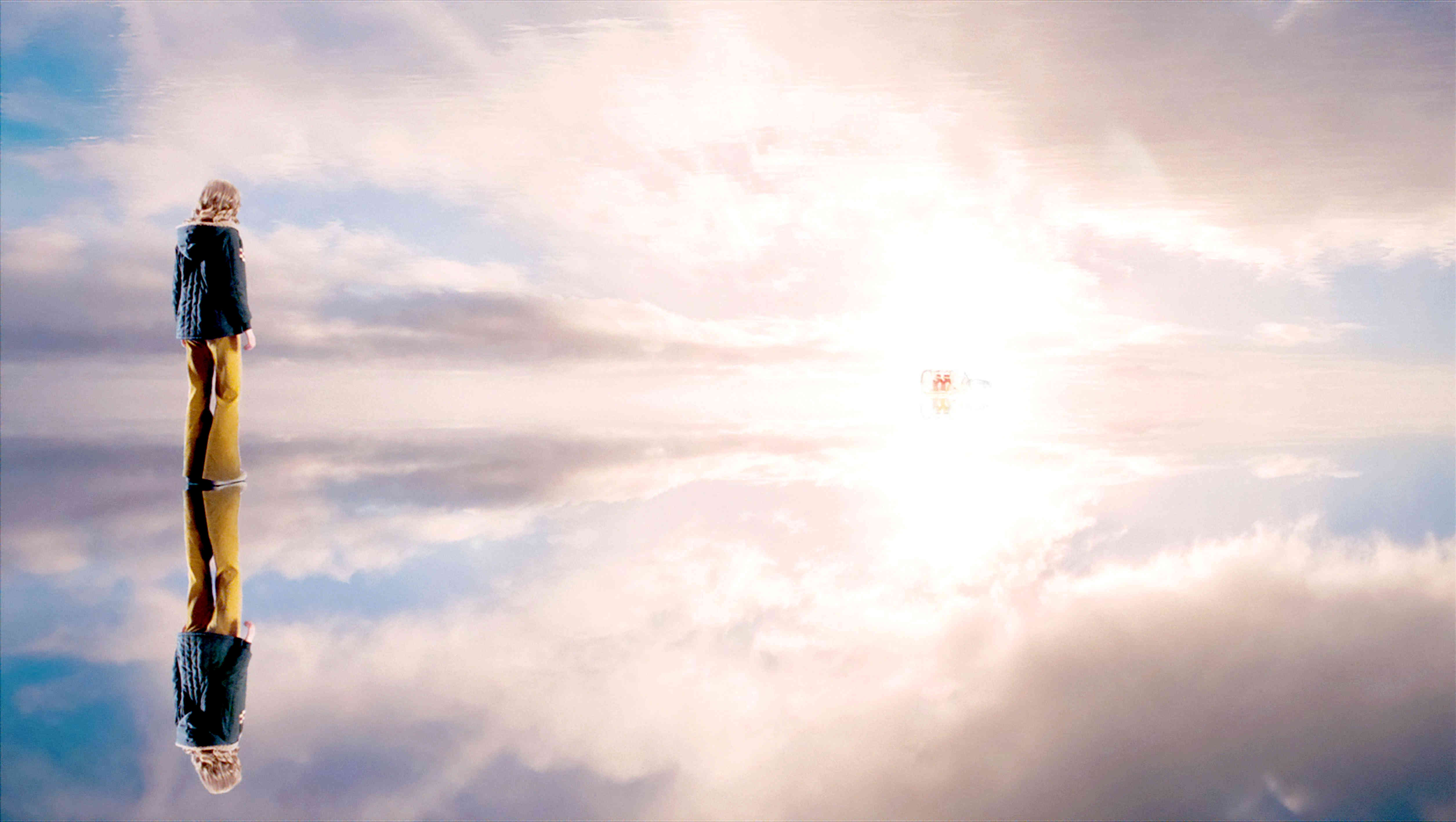
Puzzling throughout, at once exploitative and tender, The Lovely Bones (2009) is one huge enigma of a movie. For Peter Jackson, it marks a formidable attempt of reclaiming the territory he once started to explore – namely, the murderous twists and turns of hyper-active, hyper-sensitive minds that made for the folly and the mess of Heavenly Creatures (1994). In The Lovely Bones, tables are being seemingly turned, since this time we follow the victim’s perspective. But this proves alarmingly irrelevant: Jackson makes his movie so convoluted and spastic, that it seems much more a product of the villain’s mind than an object of cool, otherworldly recollection of the girl he murdered.

The imagery of the CGI-heaven that The Lovely Bones largely relies on has been much-ridiculed elsewhere, and it indeed plays like a mid-1990s TV ad; one that would pass as “amazing” back then, but that seems sloppy by today’s Lord of the Rings-set standards. But it’s not the mishandled CGI-brush that’s Lovely Bones’ biggest problem. In the pursuit of rendering his villain’s presence ominous and creepy (a feat accomplished only too well), Jackson drained the opposite pole of the movie’s universe – namely, the little girl’s family – of all interest. Rachel Weisz is game to play anything, but lack of direction is painfully on display in her performance. Mark Wahlberg is doing a new shtick, all right – mumbling his lines with eyes gone loose in different directions – but he barely does anything else. The same goes for  Michael Imperioli, who seems at a complete loss and radiates the desperate will of escaping his Sopranos image. Again, no firm direction going on.

This is a second recent movie, after David Fincher’s Zodiac (2007), that takes a conscious look at the 1970s and a makes a psychopathic killer a center of its focus. Unlike Zodiac, The Lovely Bones is set on ultimately comforting the viewer, but at the same time the relish Jackson takes in disquieting his audience is so evident, that it makes the film feel disjointed. Who’d have thought that it will be bad taste, of all things, that will bury Peter Jackson latest effort…?

Saturday, February 13, 2010

Cultural Blog of the Year 2009 Award


I’m happy to inform about the recent success of the Polish version of my blog. On 11 February, it was awarded as the Cultural Blog of the Year 2009 in a nation-wide competition sponsored by Onet.pl, one of the largest portals in Poland. Since I consider both my blogs really a one entity (hence Jimmy Stewart lurking on both sites, only in different directions) – I wanted to share this news with you as well.

Here is a photo of me receiving the award.

Friday, February 5, 2010

Lourdes (2009, Hausner)


Rating: ****

Amazingly assured and super-cautious in tackling its controversial subject matter, Jessica Hausner’s Lourdes (2009) engages so many contradictory strategies it’s a wonder it doesn’t implode. Its mode both satiric and investigative, detached yet full of quiet wonder, the movie announces the arrival of a major directorial talent.

The story follows Christine (Sylvie Testud), a young woman of a rather rationalist mindset, suffering from multiple sclerosis. Wheelchair-bound, she decides to visit the famous Lourdes pilgrimage center, built around a cave that supposedly saw a visitation by the Virgin Mary. Even though not very religious, it’s Christine and not any of the truly pious pilgrims around her who experiences a miracle (or was it one…?) and starts walking again (we don’t learn whether this will prove a permanent recovery).

The way the narrative is structured, it’s both firmly centered on Christine and flooding her story with an overwhelming, steady commotion of a religious event running 24/7. The magnificent opening shot firmly establishes the large dining room as a space that will recur a number of times. It is so carefully choreographed and so seamless in the way it honors multiple, distinctive human presences that it made me think of Jacques Tati’s large set pieces.

Indeed, the Tati link only proves stronger as the movie progresses. The constant movement of small and big human groups – purposeful yet almost abstract in their appearance – is taken straight from Playtime (1967).  Lourdes even has some of that film’s sense of humor, as Hausner directs our attention to various paces each pilgrim assumes, and to the various means they use to do it (electric & standard wheelchairs, crutches, etc).

Hausner is great at the very same thing Tati was: namely, showing human conduct as a funny, absurd (but relatively harmless) ritual. There’s a brief scene in Trafic (1972) in which a priest, picking up pieces of a smashed car engine, looks as though he was preparing the communion wafers to be handed out. It is the same amused and curious look that Hausner turns onto the religious goings-on in the pilgrimage center. (See the Tati fragment here, starting at 1:40)


The use of sound is as thoughtful as the camerawork. When we see Christine making her way to the cave, we hear a mass going on (words and music amplified by speakers), but we never see the ritual itself: it’s like a tapestry, a given, an irrelevant background the women doesn’t care about, and yet which influences her life in a way she’s not quite ready for.

Hausner is great at using gentle zooming and slight focus-pulling (see the scene of Christine’s confession for the latter). But the area of her biggest strength is the framing. Towards the end of the film, there’s a scene in which Christine realizes that her gift may well be taken away from her (or maybe it wasn’t a gift at all, but mere coincidence to start with). As she keeps leaning against the wall for assurance, too afraid to make a step, I was sure Hausner will push the camera in her face and make us see the anguish “even better”. Nothing of the sort. The camera remains remote, and still our sympathy and fear are piercing. Terrific movie.

Wednesday, February 3, 2010

For the Love of Movies: The Story of American Film Criticism (2009, Peary)


Rating: **1/2

Rudimentary in its technique and pretty standard in its ominous-yet-hopeful conclusions, Gerald Peary’s For the Love of Movies: The Story of American Film Criticism (2009) is just what its title promises it to be: no more, no less. Structured mainly by the off-screen narration read by Patricia Clarkson (and written by Peary himself), the film is interesting as a series of interviews – some of which are actually top-notch.

My chief reservation about the film is the narrowness of its scope, best seen in the omissions Peary decided to make. Of course, titling one’s movie a “Story” (as opposed to a “History”) is  a preemptive strike against all the nagging completists out there who like to point their fingers at what’s missing. Still, even the most sympathetic viewer must be astounded by how much For the Love of Movies doesn’t say.

To start with, it doesn’t draw any institutional context whatsoever as far as film periodicals in the States go. “Film Culture”, “Film Comment”, “Cineaste” – publications with great contributions to promoting critical thought – aren’t discussed at any length.

What’s more, by hastily passing through all the interviewees the makers didn’t manage to coax into cooperation, Peary skips large patches of high-quality American film writing of today. Elvis Mitchell is being celebrated for his African-American perspective on popular cinema, but how on earth could Peary have broached the subject and not even mention the stunning work of Armond White, is still beyond me. The LGBT voices in American film criticism are not mentioned at all, save for a tiny bit seen in the Extras section. What a shame: to have Rex Reed speaking to the camera and yet not inquire at all about how the gay perspective became acceptable over the years...

David Denby and Anthony Lane – great writers, whatever the controversies around them – are barely mentioned as Pauline Kael’s heirs at “The New Yorker” (Peary skips Terrence Rafferty’s brief reign there). John Simon is not discussed at all, save for one of the DVD extras. Parker Tyler – the same. Robert Warshow, for crying out loud – missing, too (I’m not counting a passing reference). Some of the interviewees aren't even asked about their specific ways of looking at films (a great loss in the case of J. Hoberman, who comes off mainly as a DeMille-influenced Sarrisite, with all of his striking output simply not discussed or even described).

Also, the rejuvenation of cinephilia that we owe to exciting DVD releases of late (and to writers like Dave Kehr, for example) - doesn't enter Peary's narrative.


Overall, it’s the eponymous “love” that saves the movie. One DVD extra reveals Perry as being truly passionate about his subject. Some of that passion seeps into his film – namely, the mere fact of its existence is joyous enough and while watching For the Love of Movies I felt giddy just because I felt someone may be so affectionate towards a topic I love so much myself. It’s too bad Peary didn’t shape his movie into a more coherent and more informative whole, but still – a couple of the interviews are great and it’s sort of a guilty pleasure to watch some of the imaginative “us” justifying their (“our”) trade and a way of living that being a critic ultimately is.

In a year which saw Michael Fassbender’s film critic blowing the cover by showing the wrong kind of “3” with his fingers in Inglourious Basterds (2009), it’s nice to see the profession celebrated and kind of redeemed, as well.

Sunday, January 24, 2010

About Elly (2009, Farhadi)


Rating: ****

The joy of meddling is first celebrated, then severely chastised in About Elly (2009), a stunning new feature by Asghar Farhadi, which sees the complexity and craftsmanship of his superb Fireworks Wednesday (2006) elevated to a new level.

Over a weekend at the seashore, a group of well-to-do young Teheranians tries to set up their freshly-divorced friend Ahmad (Shahab Hosseini) with an amiable yet aloof kindergarten teacher Elly (Taraneh Alidoosti) – whom none of them knows too well. Running into adversities is the theme from the start, when it appears that the house they booked is available for one night only, and all have to switch for a spacious but run-down mansion, devoid of heating and hardly even furnished. As the relaxed time passes (an obligatory game of charades, some white lies told to the landlady), it’s difficult to say if the supposed affair buds or not. Then, all of a sudden, Elly disappears.

The comparison with Antonioni’s L’Avventura (1960) – a knee-jerk reaction for any cinephile – is actually wrong. Farhadi’s world is too dense with mundane details to become the kind of environment that could dilute a person to the point of disappearance – and that was what the sun-scorched, abstract island did to Lea Massari’s ‘Anna’. In About Elly, the central event is rapid, violent and causes real and widening rupture – whatever happens afterwards, has as much to do with a denouement as it has with an entirely new plot being built from scratch by the ever-lying, self-protective characters. Farhadi shown his interest in deception in Fireworks Wednesday, as well – he’s one of the few directors I can think of that doesn’t relish in it, though. The lies told by his characters are clear to us – we may even find them humorous at times – but we are never encouraged to cheer them or wish for them to pile up. Quite the contrary: at some point, their proliferation makes us queasy.

In About Elly, the plans go bad and the wounds get deeper with each desperate yank any of the multiple character makes. The film’s script is tightly structured and resembles a bedroom farce, almost. (One can easily imagine this material being re-designed as a full-blown comedy). But to fully appreciate Farhadi’s accomplishment is to understand that – however crowded – this movie is really about two people: the benign über-meddler Sepideh (Golshifteh Farahani), and her main victim, who doesn’t enter the story until very late and whose identity shouldn’t be revealed in a mere note like this one. It is their brief and heart-wrenching conversation at the end (with Sepideh delivering her ultimate, shattering fabrication) that left me in absolute awe of this movie.

Monday, January 18, 2010

Up in the Air (2009, J. Reitman)


Rating: ***

Topical yet solid, the recession comedy Up in the Air (2009) is pretty shameless in exercising its sentimental grip. Thank heavens (or skies), that grip is firm enough. The script is all winks on one hand, and all Capra-sermonizing on the other. Sneers are the padding for the final upbeat message that – once launched – still makes a palpable ideological thud.

This pro-family romantic comedy, flirting heavily with social realism (and even becoming documentary at some points) gets away with its preaching by way of cleverness of characterizations. The central trio of characters – played by George Clooney, Vera Farmiga and Anna Kendrick – flaunt their technocratic mindsets so unflinchingly that it works as a sort of preemptive strike at the audience. In a movie in which the bar-pick-up-line is “Are you satisfied with your Maestro?”, there are no limits of outrage left to be crossed. Instead, there’s the gradual undermining of outrage and exposing its secret lining (i. e. the characters' derision).

Stylistically speaking, Jason Reitman (the only director to have found his baddie in Jason Bateman) is close to hackdom. Many of the scenes in Up in the Air have the rapidness of habitual card-swipes (in fact, many shots depict just that): their function is pretty much their subject. More often than not, instead of working out a clever choreography for a scene, Reitman relies on editing instead: a sad case of Clooney’s airport ballet, which smoothness is entirely based on cutting, and not on the actor’s movements.

And yet there’s one thing to be said about Reitman, the director: he knows how to relish in the constant flow of dialogue – how to make talk glitter. He’s one of the very few American directors working nowadays who can make inflections and rhythms of speech so exciting. He’s into smooth-talkers, as he’s shown in Thank You for Smoking (2004), and into wisecrackers – no better example for that than Juno (2007). But Up in the Air is a rare case of a movie that has several characters who challenge each other’s wits – and that’s something American  cinema was great at; 70 years ago. Good to see it back; however brief the visit.

PS. Anna Kendrick – a tougher and more angular version of Amy Adams – is especially impressive: hers is the only character who puts helplessness on display in spite of herself (the long scene of firing a guy over Skype is her tour de force).

Saturday, January 9, 2010

Avatar (2009, Cameron)


The opening blockbuster of the 10’s (“A fresh start in a new world”, per its narrator), James Cameron’s Avatar (2009) is a creature of whim. This self-congratulatory peacenik PlayStation-is-all extravaganza (deemed „crude and inartistic” by the World Socialist Web Site reviewer), behaves differently in various venues. It breathes well on the IMAX screen, where it more or less envelops the viewer, leaving no space for anything but gasps. Seen the second time in a regular multiplex (still in 3D), it loses much of its impact and plays more like an awesome dream of a hippie recovering from a video-game binge.

Like in many other experiential films, Avatar’s implied mode of viewership is explicitly defined in the dialogue, when Grace (Sigourney Weaver) briefs Jake (Sam Worthington) and tells him to “relax and let your mind go blank”. Those unwilling to do so are in for a bumpy ride along many blunt edges of Cameron’s famously graceless dialogue (“She wrote the book… I mean, actually wrote a book on Na’vi!”, has the ring of a high-school drop-out’s awe at a dork’s achievement; perhaps tellingly so). Those willing, like this viewer, to relish in the wonders of Cameron’s set-pieces, can experience miracles not unlike those enjoyed by paraplegic Jake, who walks in his avatar’s body for the first time in years. Human experience has never before included the sensation of looking into the tube-like depth of a hibernation chamber and watching the freshly awoken bodies float in 3D. Thanks to Cameron, it does now.

I’m willing to forgive Avatar much of its silliness; even its deflated last 50 minutes don’t bother me much. While watching it, I had a feeling of dealing with something momentous and yet transient – I doubt if the movie will age well, or indeed launch a cult, as Roger Ebert predicts (forgetting how endlessly thicker Star Wars [1977] was in its structure). Avatar wears out easily (like The Thief of Baghdad [1940]) but while it lasts it’s truly transporting and mouth-watering – it’s a sneak preview of what the 10’s spectacles will be like, and the perspective is mind-blowing.

And its discreet blood tie to Rene Clair’s Beauties of the Night (1952) – which was also built on a premise of a life lived fuller while asleep – doesn’t hurt either.