Thursday, October 29, 2009

Just Write (1997, Gallerani)


A dud in every other way, Andrew Gallerani’s Just Write (1997) at least succeeds in getting together two very alert performers: Sherilyn Fenn and Jeremy Piven. The latter, in his pre-Ari Gold days, leaves you smiling – mainly because he proves incapable of being blank. Even in scenes that require of him to play “tired” or ”resigned”, he seems eager for a next chance to flaunt his incredible energy. That corresponds just fine with Fenn’s receptiveness (and her character’s awe at having this guy thrown at her by fate). Fenn was wonderful as the confused bisexual woman in Yurek Bogayewicz’s unjustly-forgotten Three of Hearts (1993), and here she reprises her earlier role in a way.

It’s a shame that the screenplay takes the path of a rather crass satire on Hollywood crowd’s emptiness (again: pre-Entourage, but with more than four mentions of Sunset Blvd. [1950] in the dialogue). What you’re left with is a joy of the few moments when Fenn and Piven meet for the first time: his puppy-like enthusiasm at meeting a Hollywood star and her relief at speaking to someone she shares a language with. Apart from that scene, the movie is inept; it's failure symbolized by Wallace Shawn’s mechanical turn as a big-shot literary agent.


Sunday, October 25, 2009

Empire of the Sun (1987, Spielberg)


Steven Spielberg’s cinema of consolation has an unusual way of dodging all my usual defenses, which is just another way of saying that I’d buy more schmaltz from Spielberg than from any other director. But in case of his Empire of the Sun (1987) I remained more resistant than usual. The story of Jim (Christian Bale), a British boy who gets separated from his parents in WW2 Shanghai, had some very strong points, but I think Spielberg was trying too hard to avoid hopelessness the material ultimately provokes. The result is very strange: a downhill slide towards moral numbness caused by war, played out like a boy’s adventure tale (Jim’s father wears Captain Hook’s outfit at one point: a prelude to a movie that will come 4 years after).

What I consider Spielberg’s biggest talent, and what comes off well even in this movie, is his ability to desexualize child's imagination to the point of reaching a moral clarity that belongs purely to the mythical. Puerility is Spielberg’s big theme, yes, but it’s never contaminated by sexual confusion. When Jim sings a song late in the movie, his falsetto isn’t broken by any signs of mutation – even though he matured in every other way in the course of the action.

It’s not an accident that Spielberg sanitized so much of Bob Zemeckis’ and Bob Gale’s raunchiness when he was making 1941 (1979). What’s wonderful about him, though, is that his shrinking from sex doesn’t feel like bailing out on adulthood as such – it’s not a neurotic denial. His drive towards what’s pure is genuine and has a religious dimension to it that I deeply revere, even though it takes him far away from any territory one would label as realistic.

Saturday, October 24, 2009

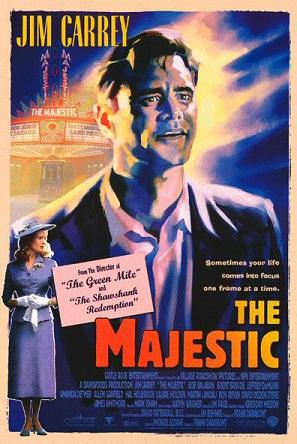
The Majestic (2001, Darabont)

Leisurely paced and thinly-plotted does not necessarily make for a deadly combo, granted that the movie in question is relaxed and entertaining at the same time (see Resnais’ Smoking/No Smoking [1993] for that). Unfortunately, Frank Darabont’s The Majestic (2001) is drunk on its own dream of moral gravitas: a mere concept that is never realized.

Sentimentalizing the innocence of a wrongly accused young man was only a part of The Shawshank Redemption (1994) appeal – here, as in Darabont’s The Green Mile (1999), it takes over the whole picture. The thing that made Shawshank… so satisfying for this viewer, was that its central character denied easy access – there was something cryptic about Tim Robins’ performance, and as an audience we kept guessing at his Andy Dufresne’s true nature (which made us automatic allies with Morgan Freeman’s character, who was doing the same thing all along). In The Majestic, Peter Appleton (Jim Carrey) is fully laid out as a character in the first five minutes of the movie – we know he’s an ambitious writer of pulp scripts and that he got blacklisted in spite of never having been a Communist. There’s precious little that would go beyond that in the following 140 minutes or so, even though a large section of the film is devoted to Peter’s assuming someone else’s identity in the wake of his memory loss. Peter is a blank noble space, with no mystery to him, and no real appeal.

Bob Balaban’s unfunny turn as a buggy-eyed, fuddy duddy HUAC clerk steers the movie – if only for a brief moment – into the territory of a historical parody, much in the vein of Spielberg’s 1941 (1979). In fact, I’d much rather see a deranged, over-the-top take on the Red Scare in Hollywood, than Darabont’s sanctimonious and sanitized fairy tale. This is yet another movie that – very much like Good Night, and Good Luck. (2006) – portrays 1950s anti-Communism as completely unfounded, which is historically incorrect. What anti-Communism was in those years, was exaggerated: a knee-jerk, neurotic reaction to a real and manageable threat that was truly at work in the USA. I would very much like to watch a movie that would encompass the era in all its tragic complexity – we could really use more works like Robert De Niro’s brilliant The Good Shepherd (2007).

Saturday, October 10, 2009

If You Could Only Cook (1935, Seiter)


In William A. Seiter’s If You Could Only Cook (1935), the negligence of Herbert Marshall’s otherworldliness is almost unbearable. He’s cast as a romantic lead opposite Jean Arthur, but Seiter’s approach to him is painfully matter-of-fact: he strips Marshall down of all the dreamlike quality that embedded him in Trouble in Paradise (1932) and Blonde Venus (1932). It’s a great disservice – suddenly, we are being confronted with all the rough edges of his screen presence (the main one being the lack of flexibility in his posture). Von Sternberg and Lubitsch had sense enough not to move Marshall around too much; and if they did, they played it safe and went for his sliding walk, which got him from A to B even though his shoulders didn’t testify to any muscle work being done. Here, Marshall’s hands are frequently mishandled; his posture frequently lacks grace. This rare bird, a marvel of a screen presence, needed to be caged to look his best.

PS. Funny how this movie uses cooking as a way of class survival and/or advancement – here’s one Nora Ephron might have watched before writing Julie & Julia (2009).


Friday, October 2, 2009

The Accidental Husband (2008, Dunne)


As a rom-com lead, Jeffrey Dean Morgan has an immediate upper hand on the likes of Ryan Reynolds and Matthew McConaughey: he looks real. It’s not that he’s a particularly good actor – his range is tiny and stretches from bewilderment to glee – but he commands a physical presence that has something to do with flesh, not plastic (ever noticed how much Ryan Reynolds’ character in The Proposal [2009] resembles Bruce Willis’ android in Surrogates [2009]…?). Morgan’s brand of masculinity – a scruffier and beefier CliveOwenism, to be exact – is not a natural counterpart for Uma Thurman’s femininity (which lacks a vulgar edge necessary to challenge Morgan’s bravado). Still, Griffin Dunne plays these two nicely against each other in The Accidental Husband (2008).

Note: the movie was made one year before Morgan’s successful turn as the psychopathic Comedian in Zack Snyder’s Watchmen (2009) and only turns up in Poland a year too late.

Thurman plays Dr. Emma Lloyd, a radio celebrity advising (mostly) women to ditch any notions of romance they may yet nurture, and to settle for “a man of their reality” (instead of “a man of their dreams”). It’s a pragmatic, unrelenting philosophy, and when we see Thurman spelling it out in the opening sequence, she’s equal to her words. She seems to be fearlessly in command; she’s a pro at dismissing daydreams. It’s only until one of these enters her own life she becomes less defiant. Love is what weaklings are made of in this story of emotional recklessness unleashed.

It’s unnecessary to reveal how exactly Morgan’s character (a Queens fireman named Patrick) gets in touch with Emma – even though it probably counts as the most contrived rom-com premise ever to enter the genre. In fact, the movie is a mess in most respects, which is kind of sealed by including Isabella Rossellini and Keir Duella: two wanderers from the upper decks of Cinema, unsure of their roles but good sports nevertheless.

There’s one scene, though, that I loved and I can well recommend the whole movie for its sake. It takes place in a wedding parlor, and Thurman and Morgan are trying out different cakes with different frostings. They don’t know each other, but they happen to play the role of an engaged couple. They’re lying away to some bystanders about their great love, and suddenly – a great moment! – they wish their lies were true. It so happens, this is the very second that they become just that.