Wednesday, August 5, 2009

Sturges' Faces


Ever noticed how brilliant Preston Sturges was in crowding his frame with a multitude of portraits?

There’s a lot to be said about using crowd in movies – Fritz Lang and D.W. Griffith would be the first to testify, along with Carné of Les Enfants du paradis (1945) finale – but what Sturges gave us wasn’t a crowd exactly. His frame is full of people, but for the most time each of them has a face of his or her own. When I watched all his available movies in a row, I was struck by the careful way he and his regular DPs devised frame compositions that offered so many living portraits at once.


Consider the scene in the surgical amphitheatre in The Great Moment (1944): many a director would play the set decoration against the people in it, making their figures seem locked into this weird and perverse structure, designed to scrutinize pain, and guts, and death. Sturges, as it were, makes us see faces, lots of them (most obviously in a shot of elderly professor addressing his students about doctor Morton’s not showing up). Watching that scene I couldn’t stop thinking about Rembradt’s “The Anatomy Lecture of Dr. Nicolaes Tulp” (1632), with seven unforgettable faces of Tulp’s students: each different, with their gazes at cross purposes (literally, symbolically and also in terms of the painting’s mere composition).


Now, Sturges was all about reaching this same effect. There are brilliant shots in Hail the Conquering Hero (1944) where one face seems literally to grow of another person’s neck, and yet another piles upon a separate group. Consider the first speech of the mayor of Oaksbridge: faces seem almost lined up for us to shift our eyes from one to another – mayor’s, his son’s , Eddie Bracken’s, his sweetheart’s, and everyone else’s in the frame, whether a character or not.


Sturges’ frame rarely – if ever! – opens up. His California (in Hail...) is no place of open spaces, as Diane Jacobs noticed in her “Christmas in July: The Life and Art of Preston Sturges”. Even when on location, we don’t get to see much of the world at large. The single sequence that covers most space in its mise-en-scene may be the bum first stealing from the hero in Sullivan’s Travels (1941), only to get killed by a train - but even than the space is blacked out (it’s nighttime) and our eyes don’t get to breathe, so to speak.


According to his biographers, Sturges loved the crowd; he relished at his packed-to-the-roof restaurant, and he consequently made his frame crammed, not with an excess of junk and props, but human faces. One of the pleasure of watching his movies is to let your eye wander freely and discover the richness of expressions, of beauty, of individuality he offered us to witness.

Friday, July 24, 2009

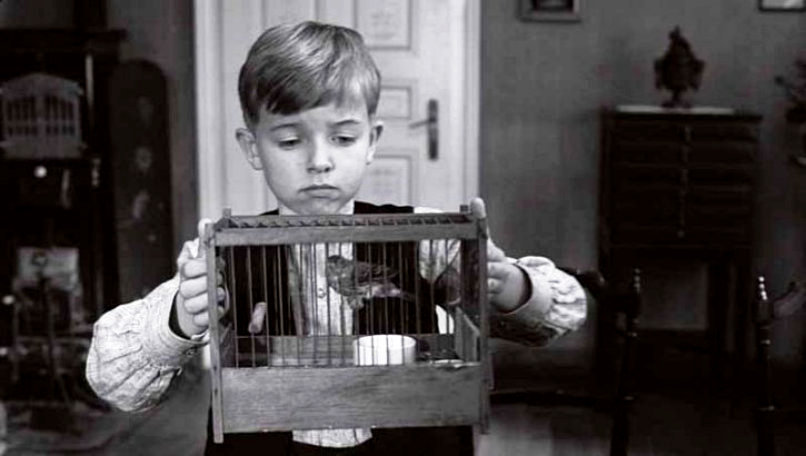
"The White Ribbon" (2009, Haneke)


LES JEUX INTERDITS

Ten years after Paul Thomas Anderson’s Magnolia (1999), with its famous off-screen narrator trying to make sense out of a series of strange incidents, comes Michael Haneke’s celebrated The White Ribbon (2009). A very different film, but it still shares a lot of themes with Magnolia: namely those of upbringing, chance, and fathers betraying their children. In fact, the title of the TV show Philip Baker Hall’s character was hosting in Anderson’s movie could well serve as a tagline for marketing Haneke’s masterwork: “What Do Kids Know?”.

A small village in Northern Prussia is haunted by a series of violent incidents during the months immediately preceding the start of World War I. Someone stretches a tight rope between two trees, thus making the local doctor’s horse trip and severely injure the rider. Someone (else…?) kidnaps and mistreats the local Baron’s son, seemingly in an act of Old Testament-inspired revenge (Haneke quotes the same lines from the Bible that Anderson did in Magnolia). As those (and other) atrocious acts are being committed, the villagers nurture quiet mutual distrust.

Haneke’s main focus is the upbringing the children are receiving from their strict Protestant parents – frequent caning, sparse signs of affection, patriarchal structure of familial power, and finally, the use of the eponymous white ribbon, tied around a child’s arm to make him or her long for purity and innocence in the wake of a sin they committed.

Haneke made a gripping, monochromatic spectacle of a Protestant village clad in black, with its inhabitants perpetually composing themselves (not a hair sticks out on their heads, and Christian Friedel’s haircut will rival No Country for Old Men (2007) Javier Bardem’s in its sheer ridiculousness). In its quiet cruelty, it’s Haneke’s version of Day of Wrath (1943), where both human bodies and souls are imprisoned by the culture that stresses condemnation rather than redemption. The crucial difference, though, is that Haneke’s focus is on the children. „I gave God a chance to kill me” is a line of almost Shakespearian resonance, but – when delivered by a 10-year-old – it verges on spooky. The White Ribbon’s appeal is based on that very spookiness.

The portrayed community has its prophets, too, but their insights are ignored or misunderstood (Ordet [1955], anyone…?). Both the slightly retarded Karl (Kai-Peter Malina) and the frightened Ernan (Janina Fautz), who claims she had dreamt of all the terrible happenings before they occurred, seem to have something important to say, but the adults fail to listen. In fact, the incomprehensible blabber of Karl reminded me of the deaf-mute girl from the penultimate shot of Code Unknown (2000) – she, too, was desperate to communicate something, but lacked the language that anyone around would share with her. Just like Caché (2004), the movie is focused on the impact an unseen perpetrator has on family unit(s) caught off guard. Unlike in Funny Games (1997), the evil doesn’t give you its white-gloved hand to shake first. It stays in the shadows, defies exposure, and it radiates onto everyone involved, no matter how noble their (here: the teacher’s) intentions are.

I called The White Ribbon a masterwork, because that’s what I believe it is within Haneke’s oeuvre, but it doesn’t mean it ended or resolved my problems with Haneke himself. In fact, there are scenes (especially the “break-up scene” between the doctor and the midwife) in which one can feel the relish Haneke is taking in torturing his characters just for the sake it. Another scene, in which the Baron’s wife (Ursina Lardi) openly denounces the “malice and fear” pervading the village, is completely false in the light of the fact that Haneke did precious nothing to show anything but malice before, so those lines seem more like the voice of his repressed screenwriter’s conscience than a sign of any genuine concern.


Friday, July 3, 2009

"Public Enemies" (2009, Michael Mann)

Given its plural, Wellman-amplified title, it shouldn’t come as a surprise that Michael Mann’s Public Enemies (2009) is a movie at war with itself. It’s an interesting war, though, and even if its first casualty is coherence, then something important is won, too. The main aesthetic antagonism here lies in a clash between the ultra-sharp, inherently-gritty HD camerawork , and Mann’s fondness for the painterly composition of the frame. Even when the objects and people on the screen are at their sharpest and the skies at their most overexposed, Mann is careful to throw in some cobalt blues or dark gold – his two colors of preference in Public Enemies.

This is the second John Dillinger movie I saw (the first one being the 1945 version by Max Nosseck), but it’s obvious that Mann is indebted to the gangster genre as a whole, rather than to any particular title. Surprisingly though, he doesn’t include many staples of the gangster pics – there’s not much humor going on, for example; no funny lugs as sidekicks, etc. What Mann does provide, though, is violence, longing and prescience of death – and these were always the cornerstones of screen crime.

As interesting and daring as Public Enemies is, I had problems with two things. First, some of the casting choices troubled me quite a bit. After watching the trailer, I was excited about seeing Marion Cotillard being freed from the heavy burden of crude make-up that made her Oscar turn in La Môme (2007) so stifling for me to watch. But it turned out I don’t buy her as a 1930s American girl, either. Something about her looks suggest an excessive depth, or rather a lack of fleeting shallowness that any gangster mole should have in her. Vulgarity is needed in such cases, and I don’t think Cotillard can be vulgar.

Also, Billy Crudup was a disappointment as J. Edgar Hoover. I don’t even want to mention how crass and homophobic the only hint of his sexual orientation here is (“Tell him he can call me J.E.!”), but Crudup does a caricature of an authority-starved square that I don’t think is true, or even enjoyable. I prefer Bob Hoskins in a much lesser movie, Oliver Stone’s Nixon (1995).

My second problem with the film is its meant-to-be-solemn indictment of FBI brutality, which has some fashionably abugharibish tone to it. Don’t get me wrong: I don’t think Abu Gharib got even half of a coverage it should have in contemporary American movies, but somehow the parallel Mann draws between Hoover’s eagerness to embrace torture and Mussollini’s taking of Ethiopia doesn’t strike me as particularly bright (Hoover even quotes from Mussollini in this film, something about “taking off the white gloves”).

Don’t get me wrong. I’m complaining, but I still think it’s a remarkable movie. It’s just that it made me crave for perfection: a giddy feeling that was first induced, and then not exactly fulfilled by Mr. Michael Mann.